A Listening Walk for Noticing Music in the Street
A listening walk helps you notice how street music shifts with distance, rhythm, and surrounding sounds, without chasing venues or naming artists.
You can take a listening walk without tracking down a band or even deciding whether a sound counts as music. A listening walk through a city lets you notice how rhythm, distance, and everyday noise change what reaches your ears. Choose a short route you already know, leave room for pauses, and treat whatever you hear as material for attention—not a performance you need to identify.
What should a listening walk ask you to notice?
For this walk, the central question is simple: what changes as you move? A melody might become clear, blur into traffic, then return around a corner. A repeated beat may come from a bus engine rather than a drum. The point is not to settle the source; it is to notice how your position and the surrounding sound shape the experience.
Keep the walk low-pressure. You do not need headphones, a recording, a destination, or a perfect quiet moment. A familiar block, a side street, and a place to pause are enough. If the street feels busy or uncomfortable, choose another route or stop. Listening should not distract you from crossing safely or respecting the people around you.
How can you choose a short route?
Pick a route with a few ordinary changes in sound: perhaps a main road, a sheltered stretch beside buildings, and a small open space. Familiarity helps because you can give your attention to listening instead of route-finding. Avoid turning the walk into a hunt for a particular musician, venue, or neighborhood stereotype. The sounds you notice can come from people, machines, buildings, and their overlap.
Before setting out, decide on a modest boundary: one loop, a few blocks, or a walk between two places you already visit. Keep your phone away unless you need it for navigation or safety. If you do use it, do not record people without their permission. A listening walk can stay in memory; it does not need to become documentation.
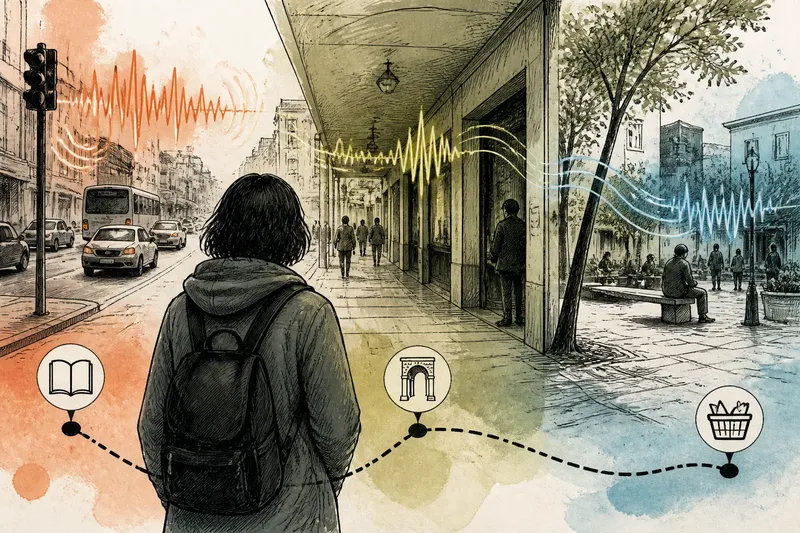
Imagine you are walking from a library to a corner grocery along a route you know. You start on a traffic-heavy street, pass an arcade with a covered sidewalk, and finish in a small plaza. You have no artist or venue in mind. Your only prompt is to notice what becomes louder, softer, clearer, or harder to separate as you move.
What should you listen for at each point?
At the beginning, notice the sound bed: traffic wash, footsteps, voices, ventilation, birds, or a distant radio. Do not try to name everything. Pick one sound that repeats or holds your attention, then ask how it sits beside the rest. A bass pulse from a passing car may briefly line up with the rhythm of someone walking; the coincidence can be interesting without needing an explanation.
As you move, listen for distance. A sound may arrive as a vague shimmer before you can tell whether it is a voice, a speaker, or an instrument. Notice when it sharpens, when buildings muffle it, and when another sound covers it. This is not a test of hearing or a puzzle to solve. Let uncertainty remain if the source never becomes clear.
At the covered sidewalk, the hypothetical walker hears a thin, repeating phrase that seems to come from ahead. Near the arcade opening, traffic masks it; under the roof, the phrase becomes easier to hear, though its source remains unclear. The walker does not follow it into a private or crowded space. Instead, they pause in a public spot, notice the phrase’s repeated shape, then continue toward the plaza.
At the plaza, listen for rhythm without assuming that every regular sound is a beat. Footsteps, wheels over paving, a signal, and fragments of music can make patterns together. Ask whether the rhythm feels steady, interrupted, or changed by your own pace. You can slow down or stand still where it is safe, then listen again. Your movement is part of what changes the sound you receive.
How do distance, rhythm, and surrounding sound work together?
These prompts are related, but they are not interchangeable. Distance affects detail: a far-off tune may lose its words and become a contour or pulse. Rhythm draws attention to repetition, whether it comes from music or the street. Surrounding sound decides what can be heard alongside it. Think of a sound like a note held behind a partly closed door: moving closer may reveal its shape, while a passing vehicle can cover it again.
Try listening in short passes rather than concentrating hard for the whole walk. First, attend to one sound that seems musical. Next, notice what interrupts or supports it. Finally, pay attention to how your own location changes the balance. You are not required to hear a complete song, identify a source, or extract a message from every block.
In the invented walk, the plaza brings the clearest change: the traffic remains audible, but open space gives a brief musical fragment room to stand out. When the walker returns to the main road, that fragment disappears beneath the general wash. The observable result is not a discovery about the neighborhood. It is a small, specific note about the route: one sound became easier to hear under cover and was lost again in open traffic.
What questions help when a sound catches your attention?
Do I need to identify the music?
No. You can describe a sound by its shape, pace, volume, or distance without naming an artist or genre. If a source becomes obvious, that can add context, but it is not the goal.
What if I hear no music?
Listen for rhythm, pitch, repetition, or changes in texture among everyday sounds. If nothing stands out, the walk still gives you a chance to notice how the street’s sound shifts from one place to another.
Should I stop and listen more closely?
Pause only where you can stand safely without blocking other people. You can also keep walking at an ordinary pace; the changing distance is part of the listening.
Can I take notes during the walk?
If it helps, jot down a few words after you stop or once the walk is over. Keep the note observational—such as “muffled pulse under the arcade”—rather than guessing about a person or their purpose.
How can you finish without turning the walk into a task?
At the end, take a moment to recall one change: a sound that grew clearer, a rhythm that fell apart, or a stretch where voices and traffic blended. You can write one sentence or simply keep the observation. Avoid grading the route as lively or quiet, and do not treat one walk as a complete portrait of a block. City sound changes with people, weather, activity, and time.
For the hypothetical library-to-grocery walk, the walker might remember the covered sidewalk as a place where a distant phrase briefly surfaced. That is a useful result because it describes an encounter rather than assigning the whole area a musical identity. On another day, a different sound—or no obvious musical fragment—may occupy the same stretch.
A listening walk works best when attention stays flexible and your route stays ordinary. If you want to repeat it, keep the same path but change the prompt: follow a sound as it fades, notice a recurring rhythm, or listen for what gets masked. The phrase “listening walk” does not require a special itinerary; it can simply remind you to notice one change in the street before you reach your next stop.