The City-Sound Myth: A Neighborhood Is Not One Genre
A neighborhood is not one genre. Learn to hear overlapping scenes, audiences, and influences before reducing a city’s music to a single style.
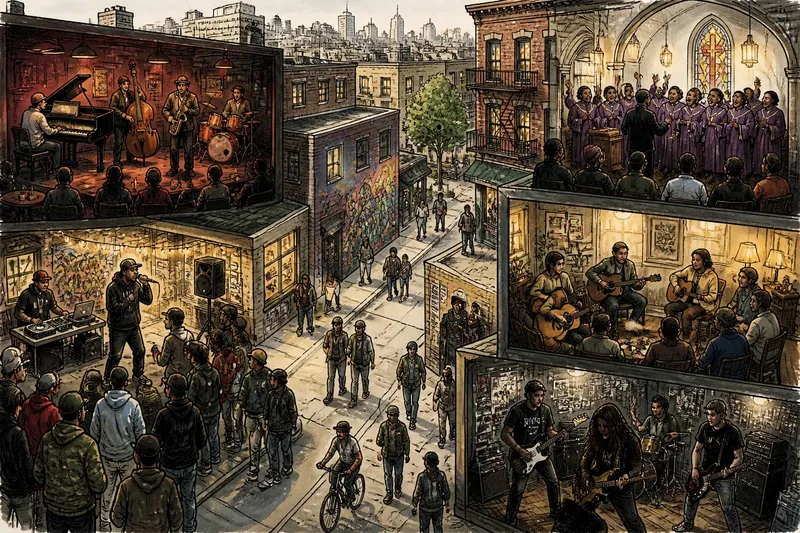
A neighborhood is not one genre, even when one sound dominates a playlist, a venue’s calendar, or a visitor’s first impression. To understand a place’s music, listen for who is making it, who gathers around it, and what other sounds share the same streets.
That takes more than swapping one label for another. A place may be known for dance music while its residents move between gospel, rap, folk, metal, jazz, and home-recorded experiments. Those sounds can overlap without blending into a single local style. A useful way to notice the difference is to follow a neighborhood’s music for a week, paying attention to the settings and communities that shape what gets heard.
Why does one genre become the neighborhood’s label?
A musical shorthand usually begins with something visible: a cluster of clubs, a celebrated performer, a recurring event, or a sound that travels well beyond its origin. The label then becomes a convenient way to tell a story about the place. Convenience, however, can turn one part of a scene into the supposed whole.
Local music is not a map with neat borders. Artists can share a block without sharing an audience, and listeners can support several scenes without treating them as one. A neighborhood’s best-known sound may be genuinely important and still leave out the musicians who play at churches, community centers, apartment gatherings, cafés, rehearsal spaces, and small events.
Pay attention to who is doing the naming. A venue might describe its nights by genre to help people choose an event. A promoter might use the same label to reach a particular audience. A resident might use a different word, or none at all, because their listening habits cross categories. Each description can be useful in its own setting; none automatically speaks for everyone who lives nearby.
What should you listen for across a week?
Use one ordinary week rather than trying to tour every part of a city. The aim is not to collect a representative sample. It is to notice how musical activity changes with place, audience, and purpose. Choose a neighborhood you can visit or follow through local listings and community media, then keep a few brief notes.
- On the first day, list the labels you already hear. Look at event listings, storefront posters, venue calendars, and community announcements. Note the genres attached to events, but treat them as starting points rather than verdicts.
- On the next day, compare the settings. Look for music advertised by a bar, a faith community, a library, a school, a cultural association, or a public event. Ask what each space makes possible: dancing, listening quietly, singing together, learning, celebrating, or meeting neighbors.
- Midweek, check who the invitations seem to address. An event’s language, location, timing, and format can suggest whom organizers hope to reach. Avoid assuming you know the actual audience from an announcement alone.
- Later in the week, follow one connection. If a musician, organizer, or local listing points toward another event or style, follow that lead. Look for a shared collaborator, instrument, language, audience, or venue rather than forcing the two sounds into one genre.
- At the end of the week, revise your first description. Keep the label if it still helps, but add what it leaves out. A phrase such as “a prominent club sound alongside community singing and independent guitar music” says more than a single genre name.
This routine is a way to listen, not a claim that a week can capture an entire neighborhood. If a listing is incomplete, mark the gap instead of filling it with a guess. If a gathering is private or intended for a particular community, respect its boundaries rather than treating access as part of your research.
How do overlapping influences become audible?
Start with the details that can be heard or checked. Notice instrumentation, rhythm, language, vocal approach, production, and the kind of participation a performance invites. Then separate those observations from the story you attach to them. A drum pattern can suggest a musical connection, but it does not by itself explain who carried that influence, what it means locally, or whether the artists identify with the same tradition.
Genres are often useful as shared vocabulary. They help listeners find music, give organizers a way to describe an event, and let artists locate their work in relation to other music. The problem starts when a category is treated as a complete description of a community. A single recording might draw on several traditions, while listeners may hear it differently according to their own histories and expectations.
Imagine you see a neighborhood event advertised as a jazz night, then notice that the musicians are also listed for a community dance and a songwriter gathering. The observable result is not proof that all three events belong to one scene; it is a reason to ask how those musicians move among audiences and what changes in each setting. Their sound may shift, or the same tune may invite different kinds of attention.
Think of genre labels like the tabs in a well-used folder: they help you find a section, but they do not describe every document inside. Keep the labels that help you listen, and leave room for details that do not fit them neatly.
Who gets missed when a place is reduced to one sound?
A dominant label can make lesser-heard activity seem incidental, even when it has deep local ties. It may obscure age groups, languages, faith traditions, immigrant communities, informal collectives, or musicians who do not seek public attention. That does not mean every event needs equal coverage or that one scene is less authentic than another. It means a broad claim deserves a closer look at whose music it includes.
Consider the difference between a neighborhood’s visibility and its musical range. A touring act, a well-promoted venue, or a popular local style may be easier to find than music shared through family gatherings or community institutions. Visibility affects what outsiders encounter, but it is not a reliable measure of how many ways people make and use music.
When describing a scene, name the limits of what you have heard. “The venues I checked emphasize…” is more precise than “The neighborhood sounds like…”. If you are speaking with residents or musicians, let them describe their own connections instead of asking them to confirm a ready-made label. A person’s account is one perspective, not a substitute for every other one.
How can you describe a neighborhood without flattening it?
Use a description that distinguishes prominence from exclusivity. You might say that a particular style is strongly associated with the area, then identify the settings or communities that complicate that picture. Concrete wording helps readers hear the place without pretending that a short account can contain everyone’s experience.
- Name the setting: a club night, a community choir, an outdoor celebration, or a home-recorded release.
- Describe an audible or observable feature rather than relying on an impression such as “exotic” or “authentic.”
- Attribute a genre label to the event listing, artist, or audience using it, when that information is available.
- Distinguish a recurring local activity from a visiting performance or a one-time event.
- Say what remains outside your view instead of treating the missing information as evidence that nothing else is happening.
This language need not become a long disclaimer. A focused sentence can hold more than one truth: a neighborhood may have a widely recognized dance scene, while also supporting musicians whose work is heard in different spaces and through different networks. The point is not to make every account exhaustive. It is to avoid turning a useful shorthand into a boundary around who belongs.
What questions help you hear the full picture?
Does a venue’s genre label describe the whole neighborhood?
No. It describes how that venue presents a particular event or series, and may help an audience decide whether to attend. Compare it with other spaces and community announcements before using it to characterize the wider area.
Can one song belong to more than one scene?
Yes. A recording can connect musicians, influences, and listeners who do not share a single genre label. Describe the audible features and the connections you can support rather than assigning the song one permanent place.
How can I tell whether a sound is locally rooted?
Look for repeated ties among musicians, audiences, spaces, and community activity, while keeping in mind that a visiting artist can also matter to local listeners. One performance or poster alone cannot establish how broadly a sound belongs to a place.
What should I do if residents describe the same scene differently?
Keep the accounts distinct and ask what each person is describing: a venue, a generation, a social circle, or a personal listening history. Different answers may reveal how music moves through the neighborhood rather than indicating that one account must be wrong.
When is a single-genre description still useful?
A compact label can be practical when it accurately names the focus of a specific event, playlist, venue, or conversation. It is also reasonable to point out a style that has shaped a neighborhood’s public identity. The care lies in being clear about the scale of the claim: a sound can be central to one part of a place without standing for every person who hears, makes, or shares music there.
When you next read a city-sound claim, ask what setting it describes, whose language it uses, and which musical communities it leaves outside the frame. That small pause keeps a useful genre name in its proper role: a way into listening, not a substitute for the people and sounds it cannot contain.