Why a Rehearsal Room Changes the Sound of a Band
Why a rehearsal room changes the sound of a band: learn how room size, reflections, and player positions affect what musicians hear and how they rehearse.
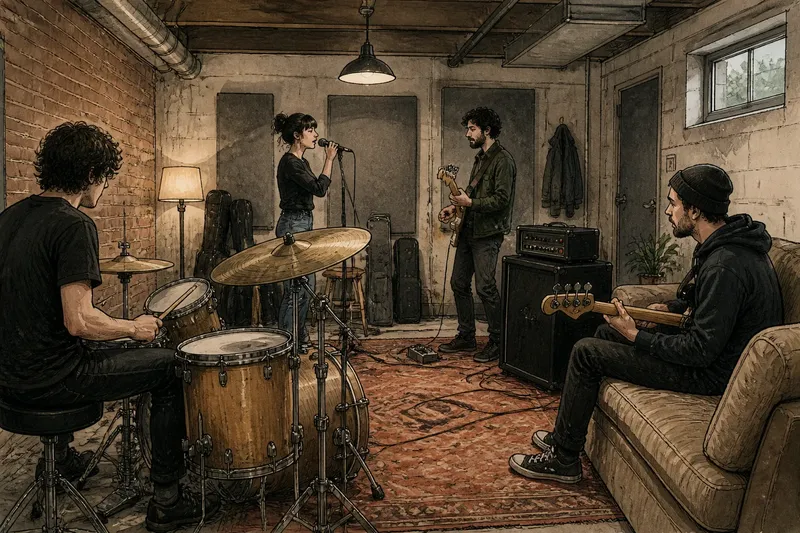
Why a rehearsal room changes the sound of a band becomes obvious when the drummer moves from the center of a bare basement to a corner beside a padded couch: the cymbals may seem sharper, while the bass feels less present. The instruments have not changed, but the room has changed the blend each player hears. Choosing a useful rehearsal setup means matching the space and positions to the band’s immediate need, not chasing one supposedly perfect room.
What should the room help your band hear?
Start by naming the problem you want rehearsal to solve. If the group is learning a new arrangement, clear vocal and rhythmic cues matter more than a polished, powerful sound. If the song is nearly settled, the band may need to hear how parts balance when everyone plays at once.
Room size affects how sound reaches the players. In a compact room, direct sound arrives strongly, and a loud source can dominate nearby musicians. A larger room may give sound more space to spread, but distance and reflections can blur timing or make quiet parts harder to judge.
Surfaces matter too. A bare floor and hard walls can send bright reflections back into the room, making cymbals, pick attack, and consonants feel more insistent. Softer furnishings absorb some high-frequency energy, while a crowded room full of cases, people, and stands can interrupt sound in uneven ways. Think of the room like a mirror: its shape and surfaces send parts of the sound back toward you, though not always in the same direction.
Which rehearsal setup fits your situation?
Are you learning a new song?
Choose a setup that lets players see and hear the people carrying important cues. Keep the singer and the instruments that mark entrances in clear relation, and avoid placing an amplifier directly beside someone who needs to follow the vocal. A moderate playing level helps the band catch arrangement details before volume becomes part of the performance.
Does one instrument overpower the others?
First try changing positions rather than turning up every other source. Move the loud amplifier away from the nearest player, angle it toward its owner, and give the drummer enough separation that cymbals do not wash over the singer. If the imbalance persists, reduce the dominant source and check the blend again from several spots.
Are you rehearsing a quiet or dynamic passage?
Use a quieter arrangement and place players so they can hear the parts that carry the passage, including soft percussion or backing vocals. A reflective room may make a delicate section seem busy, while a heavily furnished space may soften details; listen for the actual musical cue rather than assuming the room is neutral.
Are you preparing for a particular venue?
Use rehearsal to practice listening and adjusting, not to recreate the venue exactly. If you know the stage layout, approximate the relationships that matter, such as the singer’s line of sight to the drummer. Leave room to respond to the venue’s own reflections and monitor mix at soundcheck.
Where should each musician stand?
Begin with sightlines and the band’s listening needs. Put players who rely on visual cues where they can see one another, and avoid placing a singer behind a loud guitar cabinet. Aim speakers toward ears rather than knees, and avoid pointing several cabinets at the same nearby wall when that sends a strong reflection back into the group.
Spacing is a practical control. A little distance can separate a guitar’s direct sound from the drummer’s cymbals, while close placement can help a small ensemble communicate at low volume. Corners can make bass feel stronger or uneven, so do not use them as a default position for the bass cabinet. Make a change, play the same short passage, and ask each person what became easier or harder to hear.
Say you have a small basement room, a singer who cannot hear the vocal clearly, and a guitar amp beside the singer’s microphone stand. The band could angle the amp toward the guitarist, move it farther from the singer, and play a verse at a controlled level. The expected observable result is that the singer can judge pitch and phrasing with less guitar masking, while the guitarist still hears their own part.
How can you tell whether a room is helping?
Listen from the positions where musicians actually play, not only from the doorway. Ask each person to identify one musical detail they can follow: the kick pattern, a lyric, a bass change, or a backing-vocal entrance. If a player hears only their own source, adjust its direction or level before making a broad change to the room.
Keep the comparison simple. Play the same short section after moving one source or changing one position. Changing several things at once makes it harder to know what helped. A phone recording can reveal a lopsided overall balance, but it will not reproduce each musician’s experience or replace listening in the room.
Also distinguish a room problem from an arrangement problem. If the same part disappears in multiple positions, it may be masked by another instrument or need a different register, rhythm, or level. If it is clear in one spot and lost in another, placement or room reflections are more likely to be involved.
What does the room need to accommodate?
There is no universally ideal rehearsal room. A compact space may suit a group that communicates visually and plays with restraint; a larger room may better accommodate a loud ensemble or movement. A reflective room can expose timing and articulation, but it can also make prolonged loud playing tiring. A furnished room may feel less bright, though soft materials can make quiet details harder to hear.
Adapt the setup to the people, instruments, and task in front of you. If a space is shared, leave a clear path to doors and exits, keep cables out of walkways, and follow the room’s posted rules and equipment instructions. Make adjustments only within the safe use of the room and gear; ask the venue or a qualified technician about anything that calls for electrical or structural work.
The useful question is not whether a room sounds good in isolation, but whether the band can hear the information needed to play together. Treat “why a rehearsal room changes the sound of a band” as a listening question: identify what is missing, alter one placement or level, then decide whether that change serves the rehearsal in front of you.